
New PIT Count Reveals Family Homelessness on the Rise Across Maricopa County

The Point-in-Time Count is an annual federally required count of people experiencing homelessness conducted each January.
Families experiencing homelessness are often hiding in plain sight.
Sleeping in cars. Staying in public places like the library during the day. Trying not to be noticed.
“Families are doing everything they can to be less visible,” said Monique Lopez, CEO of UMOM New Day Centers. “Being in cars, in parking lots, trying to stay unseen. It’s all about holding the family together.”
New data from the Maricopa Regional Continuum of Care suggests that this invisible crisis is growing.
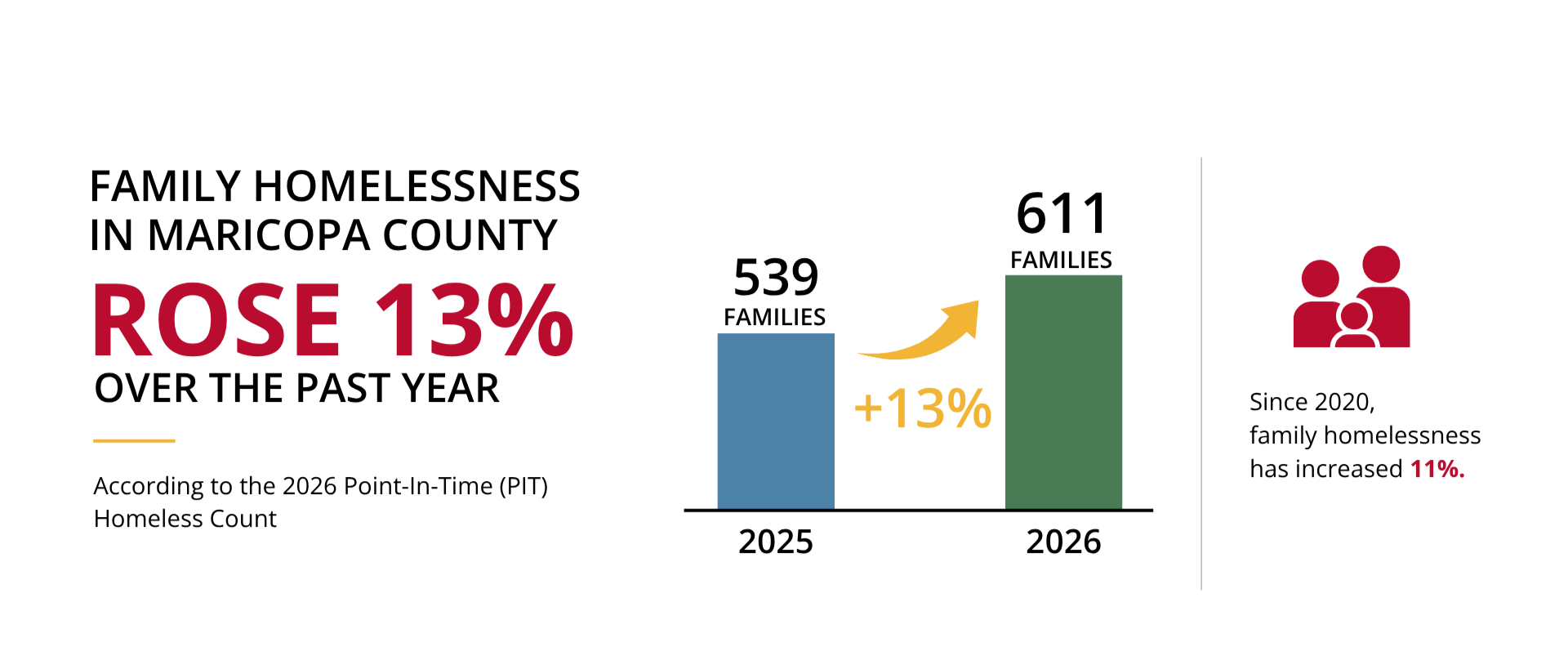
According to the 2026 Point-In-Time (PIT) Homeless Count, the number of families experiencing homelessness in Maricopa County rose 13% over the past year, increasing from 539 families in 2025 to 611 in 2026. In fact, since 2020, family homelessness has increased by 11%.
Nearly all families identified during the count were staying in emergency shelter or transitional housing, reflecting both the growing demand for family shelter and the reality that many providers across the region are operating at or near capacity.
For families who do find shelter, it is often because they reached out before becoming fully unsheltered, staying connected to emergency shelter and supportive services that help keep families off the streets.
As Arizona’s largest shelter for families experiencing homelessness, and operating 90% of family shelter beds in Maricopa County, UMOM New Day Centers helps families navigate housing instability every day. Annually, UMOM serves more than 15,000 people annually, and on any given night, more than 800 individuals stay on campus, including approximately 150 families and 80 single women.
The data reflects mounting financial pressure on working families across Maricopa County, where rents and everyday living costs continue to outpace wages. For many families, homelessness is not the result of a single failure, but the cumulative weight of rising costs, limited housing options, and economic instability.
Arizona faces one of the nation’s worst gaps in affordable rentals for extremely low-income families, with only 26 units of affordable and available homes for every 100 Extremely Low-Income households. This is a shortage that significantly contributes to family homelessness.
While family homelessness worsened in the past year, the county’s overall homelessness numbers remained relatively stable, suggesting a more complicated picture emerging across the region.
At the same time, other portions of the PIT Count pointed to modest signs of progress.
Individual Homelessness Down Slightly
The 2026 count found 9,726 people experiencing homelessness in Maricopa County on the night of January 26, 2026. This was a decrease of less than 1% from 2025. While the overall number of people experiencing homelessness stayed largely the same, data around whether people were sheltered or not tells a different, more optimistic story.
More People Connected to Shelter
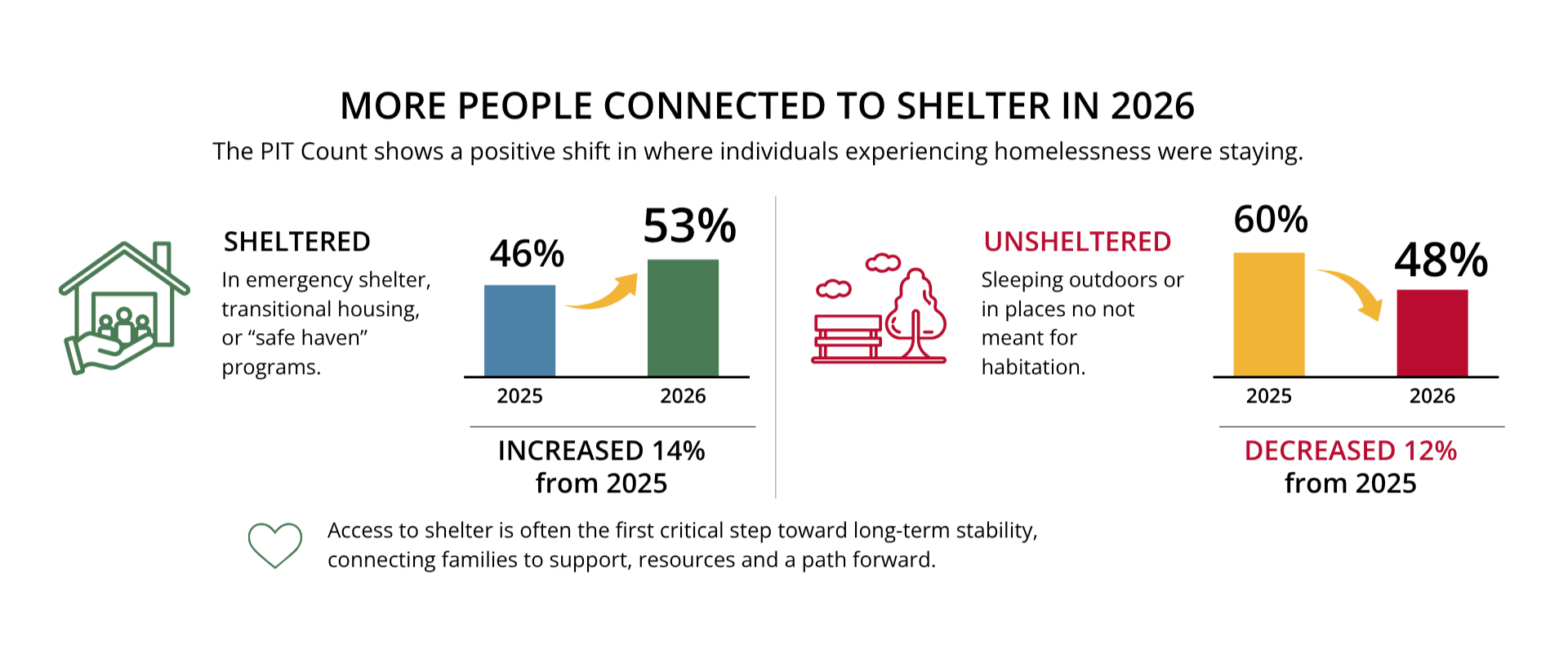
The report also revealed a notable shift in where people were staying. More individuals experiencing homelessness were connected to shelter services this year, rather than sleeping outdoors or in places not meant for habitation.
Of the 9,726 people experiencing homelessness, 53% were sheltered (in emergency shelter, transitional housing, or ‘safe haven’ programs), an increase of 14% over 2025. Meanwhile, the number of people who were unsheltered decreased by 12%.
As UMOM sees every day, shelter often becomes the first critical step toward long-term stability, connecting families to employment support, housing navigation, children's services, and case management.
The latest PIT Count shows that even as more people move indoors, family homelessness is quietly rising across the region, often remaining out of sight until families exhaust every safe place they can stay.